
Funeral flowers: a complete guide to choosing flowers for a funeral
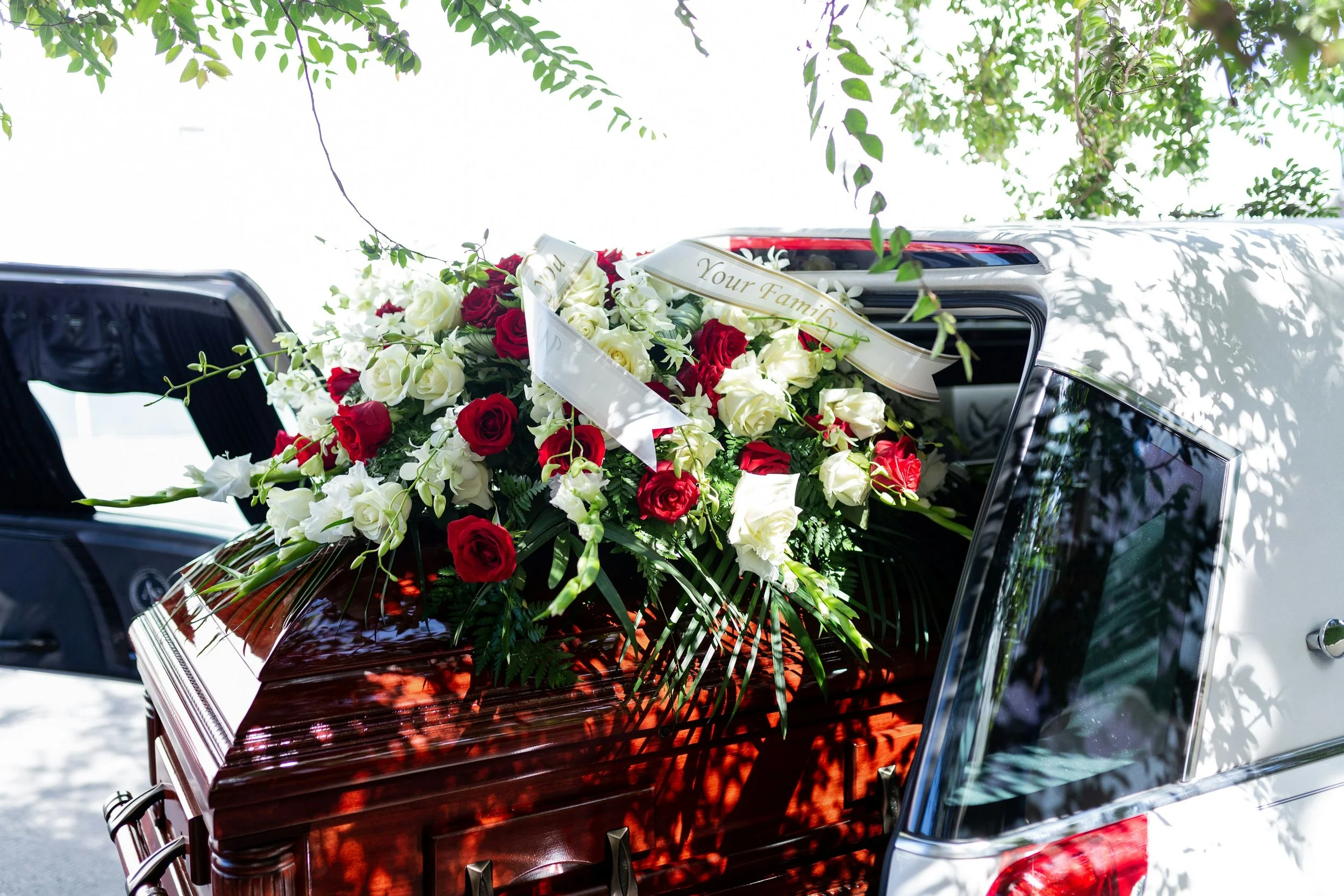
Flowers have been part of funerals for thousands of years. They’re one of the most instinctive ways we have of marking the loss of someone. But when the moment comes to actually choose funeral flowers, many people find themselves uncertain about where to begin.
This guide is here to help, whether you are arranging a funeral in London and need practical advice, looking for funeral flower ideas that feel personal and meaningful, or want to make choices that sit more lightly on the environment.
Why funeral flowers matter
A funeral is one of the few occasions where flowers are not decorative in the ordinary sense. They’re not there to brighten a room, instead they can represent love and respect, and create a sense of care and intention around the person who has died.
The right flowers can transform a service. They can reflect a personality, carry a colour that means something, or simply bring a quality of beauty to a day that is otherwise very hard. Choosing them thoughtfully is one of the most personal contributions a family can make to a funeral, and it is worth taking the time to get it right.
The main types of funeral flowers
Understanding the different forms funeral flowers can take makes the whole process easier. Here are the most common arrangements and what each one is typically used for.
Coffin flowers are placed directly on top of the coffin and are usually the most prominent floral tribute at a service. They can be a single stem, a simple spray, or a full coffin blanket covering the entire surface. Coffin flowers are typically chosen by the immediate family and tend to reflect the most personal choices of all.
Wreaths for funerals are circular arrangements that have long been associated with mourning and remembrance. The circular form carries its own symbolism, representing eternity and the continuity of life. A wreath can be simple and natural or rich and elaborate, depending on what feels right.
Funeral flower arrangements in a broader sense include standing sprays, posies, sheaves, and basket arrangements. These are often sent by friends, colleagues, or wider family as a mark of respect, and they are typically displayed at the venue during the service before accompanying the coffin or being taken to the graveside.
A funeral bouquet is a looser, more informal arrangement that has become increasingly popular. Rather than a structured formal piece, a bouquet of flowers gathered together feels closer to something you might pick from a garden, and many families find this informality more expressive of the person they are remembering.
Memorial service flower arrangements tend to be slightly different in character from those at a funeral. A memorial service often takes place weeks or months after the death, and the flowers chosen can reflect this shift in tone, moving from the rawness of immediate grief towards something more celebratory of a life.
Choosing flowers that reflect the person
The most meaningful funeral flowers are the ones that tell you something about who the person was. Here are some of the ways families approach this.
Favourite flowers are always a strong starting point. If the person who has died had a particular flower they loved, or grew in their garden, or always had in their home, that is the most direct way of bringing them into the room.
Colour carries enormous expressive power. White remains the most traditional choice for funerals in the UK, representing peace and purity. But there is no rule that says funeral flowers must be white. Bold, vivid colours can be a joyful celebration of a life well lived. Soft pastels can feel gentle and tender, while a single unexpected colour can be the most striking tribute in the room.
Seasonal flowers connect the service to the time of year, which many families find quietly meaningful. Spring blossom, summer wildflowers, autumn berries and foliage, or the stripped-back simplicity of a winter arrangement; each has its own character and resonance.
Symbolism is worth considering if it matters to your family. Roses traditionally represent love. Lilies are associated with peace and the restored innocence of the soul. Sunflowers suggest warmth, loyalty, and a sunny disposition. Forget-me-nots speak for themselves. None of this needs to be taken too literally, but it can provide a useful frame when choices feel overwhelming.
Eco-friendly funeral flowers: making sustainable choices
For families planning an eco-friendly funeral in London, the environmental impact of flowers is worth thinking about carefully. The conventional cut flower industry has a significant carbon footprint. Most flowers sold in the UK are imported, often from Kenya, Colombia, or the Netherlands, and arrive by air freight. They are typically grown using pesticides and large quantities of water.
The good news is that there are genuinely beautiful alternatives.
Locally grown and seasonal flowers are the most straightforward sustainable choice. Several London florists and suppliers now work exclusively with British growers, and the results are often more characterful and interesting than imported flowers. Seasonal arrangements have a quality that reflects the natural world in a way that imported, out-of-season blooms simply cannot match.
Wildflower arrangements suit a natural or woodland burial particularly well. Loose, unstructured, and deeply connected to the landscape, they feel right in a way that formal arrangements sometimes do not at a green funeral.
Potted plants are an alternative to cut flowers that many families find more lasting. A potted plant can be taken home after the service and kept, or planted in a garden as a living memorial.
Dried and preserved flowers have become significantly more refined in recent years and offer a sustainable option that also lasts well beyond the day itself.
Seed packets as an alternative to or alongside flowers are a growing trend at eco-friendly funerals. Guests take them home and plant them, creating a quiet, distributed memorial in gardens across a community.
If sustainability matters to you, it is worth telling your London funeral director early in the planning process. A funeral director with experience in eco-friendly funerals will have florist relationships and supplier knowledge that makes these choices much easier to navigate.
Funeral flowers delivery in London
If you are sending flowers as a mark of respect rather than arranging the funeral yourself, a few practical points are worth knowing.
Always check with the family or the funeral director before sending flowers to a service. Some families request no flowers, preferring donations to a charity in their place. Others welcome them warmly. Arriving at a service laden with flowers that were not expected can create logistical difficulties for the funeral home.
For funeral flowers delivery in London, most established florists offer same-day or next-day delivery and are experienced in working to funeral timings. When ordering, give the florist the full name of the deceased, the venue address, and the time of the service, and confirm whether the flowers should arrive before or during the service.
If you cannot attend a service, sending flowers with a handwritten note is one of the most thoughtful things you can do. It tells the family that someone who could not be there was thinking of them.
What to do with funeral flowers afterwards
This is something families are rarely prepared for, and it can feel unexpectedly poignant. After a service, there are often many floral tributes to think about, and decisions need to be made relatively quickly.
Some families take flowers to the graveside or scatter them. Others bring arrangements home and keep them until they fade naturally, finding comfort in having something from the day in the house. Flowers can be donated to care homes, hospices, or hospitals, where they are almost always warmly received. Individual blooms can be pressed and kept. Some florists and specialist companies will preserve funeral flowers into resin jewellery or framed pieces, creating a keepsake that lasts.
Whatever you choose, there is no right answer. The flowers have done their work. What happens to them next is entirely yours to decide.
Arranging funeral flowers in London
If you are in the early stages of planning a funeral in London and are not yet sure where to begin with flowers, your funeral director is your first port of call. A good London funeral director will either have florist relationships they can recommend or will be able to point you towards suppliers who understand the particular needs of a funeral, including timing, scale, and the sensitivity required.
At Exit Here, we work with families across London to arrange funerals that genuinely reflect the people they are honouring. Flowers are part of that, and we are happy to help you think through the choices, whether you have a clear vision or are starting from scratch. We are here whenever you are ready.